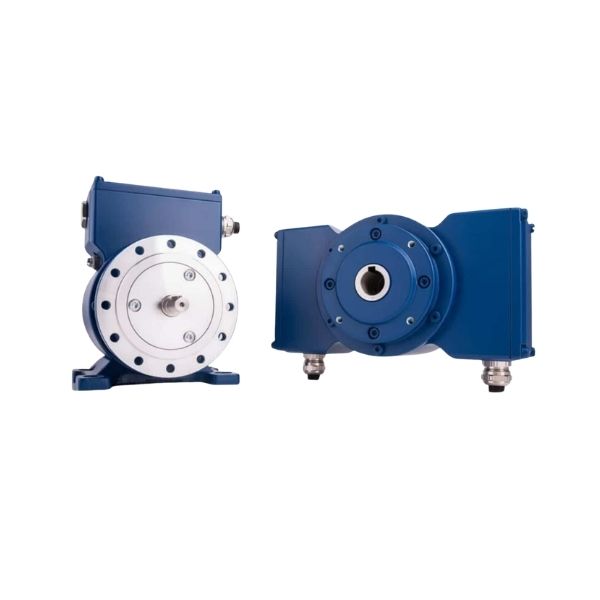
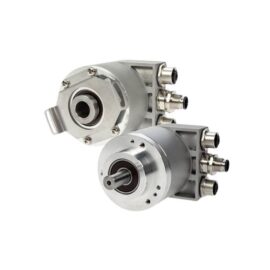
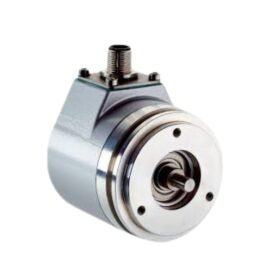
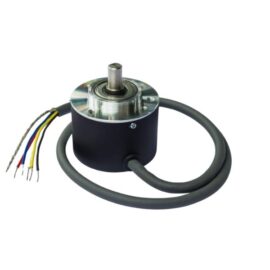
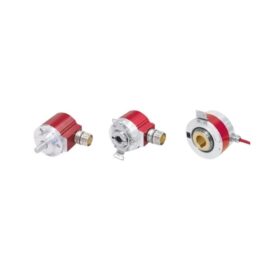
Heavy-duty incremental encoders are purpose-engineered for the most demanding industrial environments where standard encoder designs would rapidly fail. They feature reinforced aluminium or cast iron housings, large-diameter shaft bearings rated for high radial and axial loads, heavy-grade shaft sealing systems, and robust internal construction designed to withstand constant vibration, shock, and contamination exposure. Housing protection is typically IP65 to IP67 as standard, with IP69K variants available for high-pressure washdown environments. Shaft bearing life is significantly extended compared to standard encoders - supporting radial and axial loads from belt tension, gear engagement, or shaft deflection that would quickly degrade normal encoder bearings. Shaft diameters of 10mm to 30mm are common, with hollow shaft variants covering large bore applications on cranes and steel plant drives. Electrical output follows standard HTL and TTL/RS422 specifications with resolutions from 100 to 5,000 PPR for most applications. Extended temperature ratings to -40°C/+100°C cover outdoor and high-heat environments including steel mills and foundries. Vibration-resistant connectors and heavy-duty cable glands maintain signal integrity in electrically noisy and mechanically demanding environments. Heavy-duty incremental encoders are the correct choice for overhead crane travel and hoist control, steel rolling mill drives, cement mill and kiln drives, mine hoist and conveyor systems, port equipment, and any application where encoder longevity under extreme mechanical, thermal, and environmental stress is non-negotiable. Specifying a standard encoder in these environments results in repeated failures and significant unplanned maintenance cost.