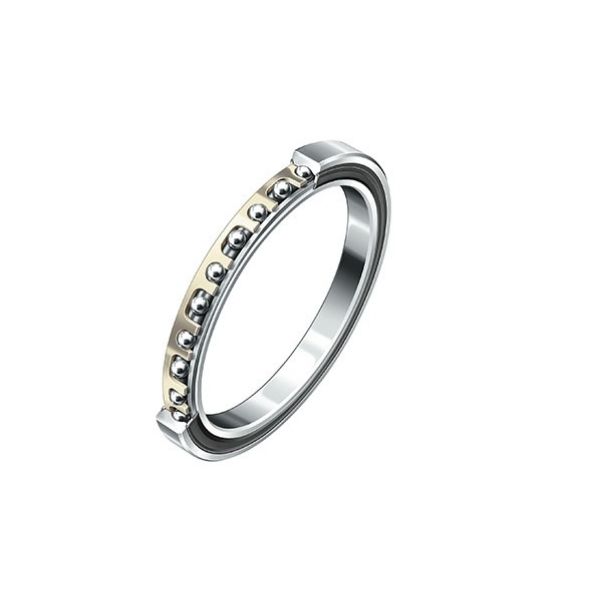
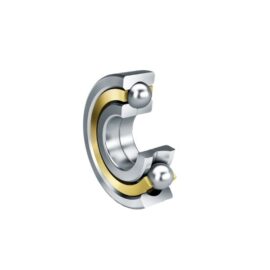
Thin section bearings are designed with an unusually small cross-section relative to bore diameter - the cross-section height remains constant regardless of bore size within each series. This enables machine designers to use large-diameter bearings for high moment stiffness and internal routing access while keeping the bearing cross-section - and therefore the housing wall thickness - very small. The result is a lighter, more compact bearing arrangement than achievable with conventional bearing series at equivalent bore diameter. Thin section bearings are available in deep groove (radial and bidirectional axial loads), angular contact (high axial and combined loads), and four point contact (bidirectional axial in minimal space) types. Bore diameters typically range from 25mm to 1,000mm or more in custom configurations, with cross-section heights as small as 6mm x 6mm for the smallest series. Precision grades matching aerospace and medical requirements are available. The bore-to-cross-section ratio advantage becomes critical in robot arm joint bearings, where large bore diameters provide routing space for cables and fluid lines through the joint while minimal cross-section keeps arm structure weight low. Similar advantages apply to medical imaging equipment gantries, semiconductor wafer handling robots, optical instruments, and aerospace actuator designs. Thin section bearings are specified in robotic joint and wrist assemblies, medical scanning and imaging equipment, semiconductor lithography equipment, aerospace electromechanical actuators, optical instrument rotation stages, and compact industrial machine designs where conventional bearing series would add unacceptable weight or structural bulk that compromises the machine's performance or design objectives.