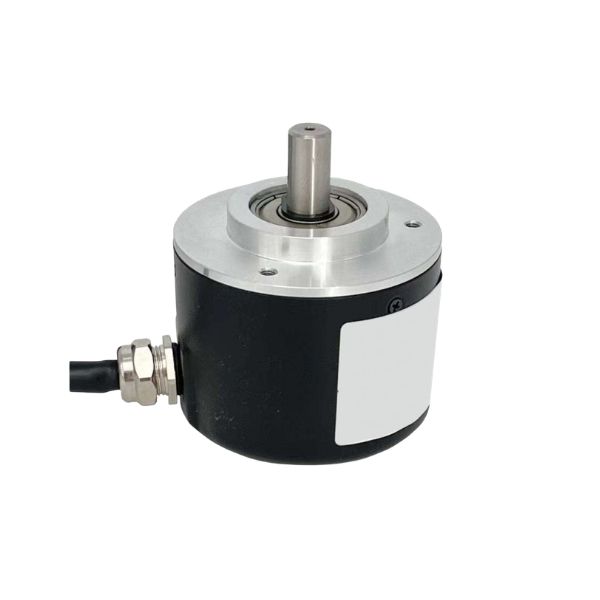
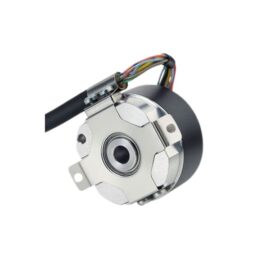
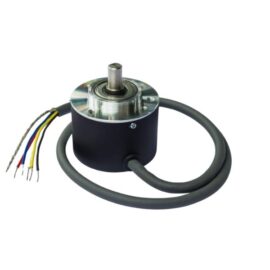
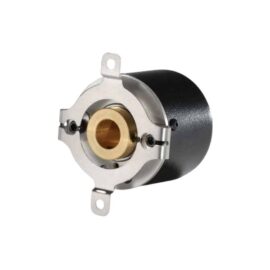
Solid shaft incremental encoders are coupling-mounted rotary feedback devices that convert mechanical shaft rotation into a precise train of electrical pulses. They attach to machine or motor shafts via flexible bellows, disc, or jaw couplings that absorb minor misalignment without transmitting mechanical stress to the encoder's internal bearing system. The encoder generates signals on Channel A and Channel B, shifted 90 degrees apart, allowing the controller to determine both speed and direction. An optional Index (Z) channel outputs one pulse per revolution for homing and referencing. Output formats include HTL (10-30V push-pull), TTL/RS422 differential, NPN/PNP open collector, and SinCos analogue. Resolutions typically span 100 to 10,000 pulses per revolution, making them adaptable to a wide range of machine designs. Housings are available in die-cast aluminium or stainless steel with IP65 and IP67 sealing options to handle dust, oil mist, and low-pressure water in typical plant environments. Shaft diameters from 6mm to 15mm cover standard motor and machine configurations. Solid shaft incremental encoders are preferred where cost-effectiveness, installation flexibility, and coupling-based vibration isolation are priorities - conveyor speed monitoring, motor feedback loops, web tension control, position counting, and process synchronisation. They do not retain position after power loss; where retained position is required, an absolute encoder should be selected instead.